
Share This Story
Today’s workforce demands more than job-ready graduates; it calls for adaptable, entrepreneurial thinkers. In response, school districts are reimagining career prep through business incubators: flexible learning environments that encourage students to pitch, build and activate meaningful solutions on their own terms.
Once reserved for college campuses, these programs are now taking root in high schools, allowing tomorrow’s business leaders to get a head start in defining their future.
From STEAM to Startups
As science, technology, engineering and mathematics (STEM) education expanded to STEAM—infusing creativity and the arts—entrepreneurship naturally followed. Now, business incubator programs represent the next step, moving beyond skills mastery to cultivate the agility and critical thinking necessary to generate business opportunities and growth.
Unlike traditional Career and Technical Education (CTE) avenues like ag-tech, workshops, maker spaces or cybersecurity, which emphasize sector-specific skills in isolation, business incubators immerse students in the full entrepreneurial journey: brainstorming, planning, branding, budgeting, marketing, selling and refining thought strategies based on feedback, steered by local business mentors, higher education institutions and industry partners.
And the need is urgent. A WEF report notes that up to 39% of workers’ required competencies will change or become outdated by 2030, because technology is moving faster than companies can handle. Yet out of 23,000+ public high schools in the U.S., it’s estimated that fewer than 200 currently host business incubator programs. This presents a major opportunity for district administrators to lead the way in growing business-savvy talent.
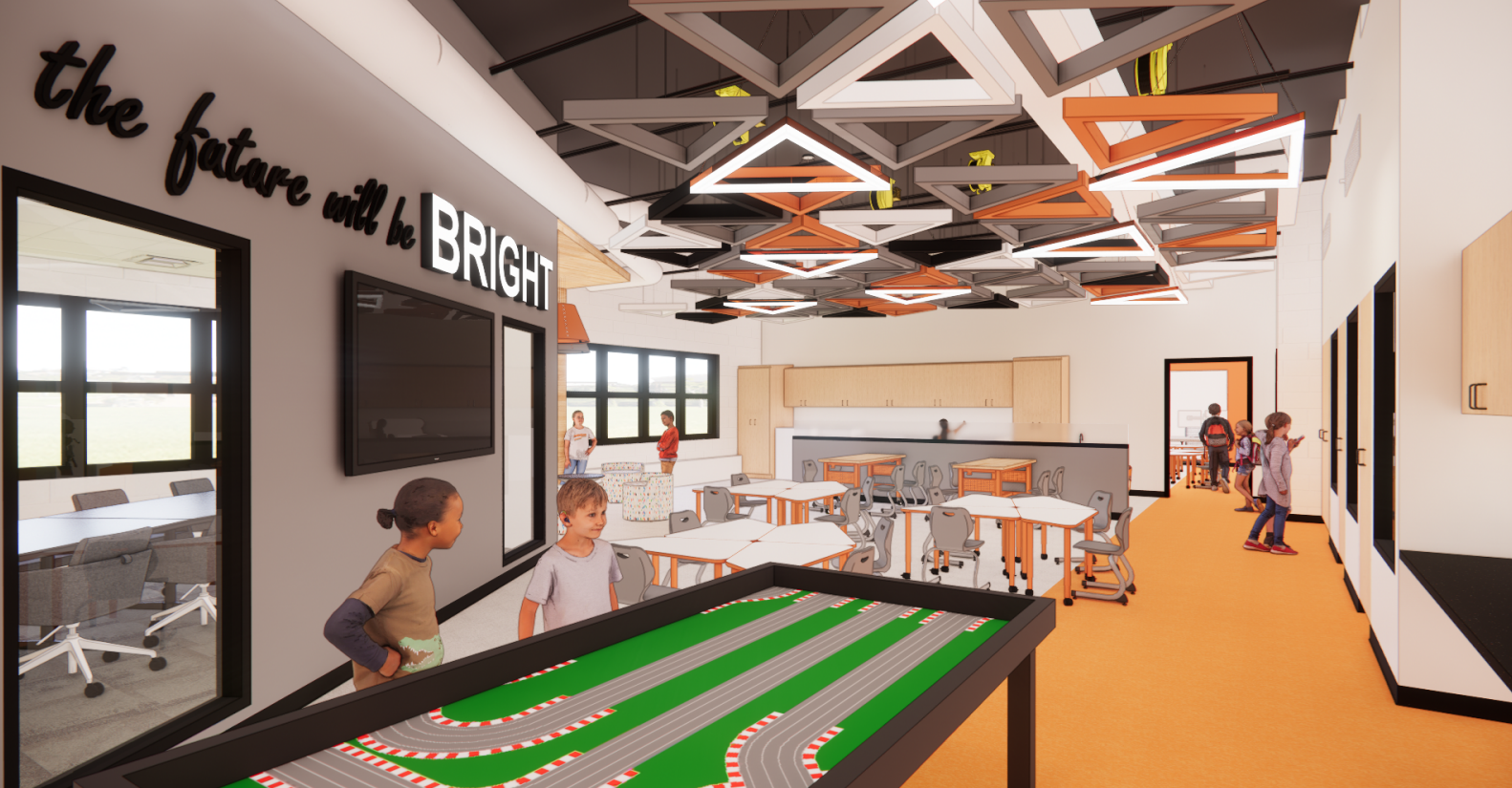
Although business incubators serve grades 10-12, the building blocks of enterprise literacy can—and should—begin much sooner. For example, Lego leagues and coding clubs can introduce fun ways to develop creative and analytical thinking through age-appropriate roleplay experiences—skills necessary later on in the business environment.
Designing a Strong K-12 Incubator
At the high school level, effective business incubators combine two essential pillars: interactive settings and student-driven programming. Breaking away from conventional classroom setups, these spaces draw inspiration from universities and corporate offices to promote experiential learning.
Simulation zones—such as mock boardrooms, stages and offices—introduce students to professional presentation scenarios. Movable furniture, writable surfaces and integrated tech (think virtual meeting capabilities) make it easy to shift between independent work, research and experimentation. Visual cues like venture boards, digital stock tickers and student-run pop-up storefronts allow learners to test and iterate business concepts in real time.
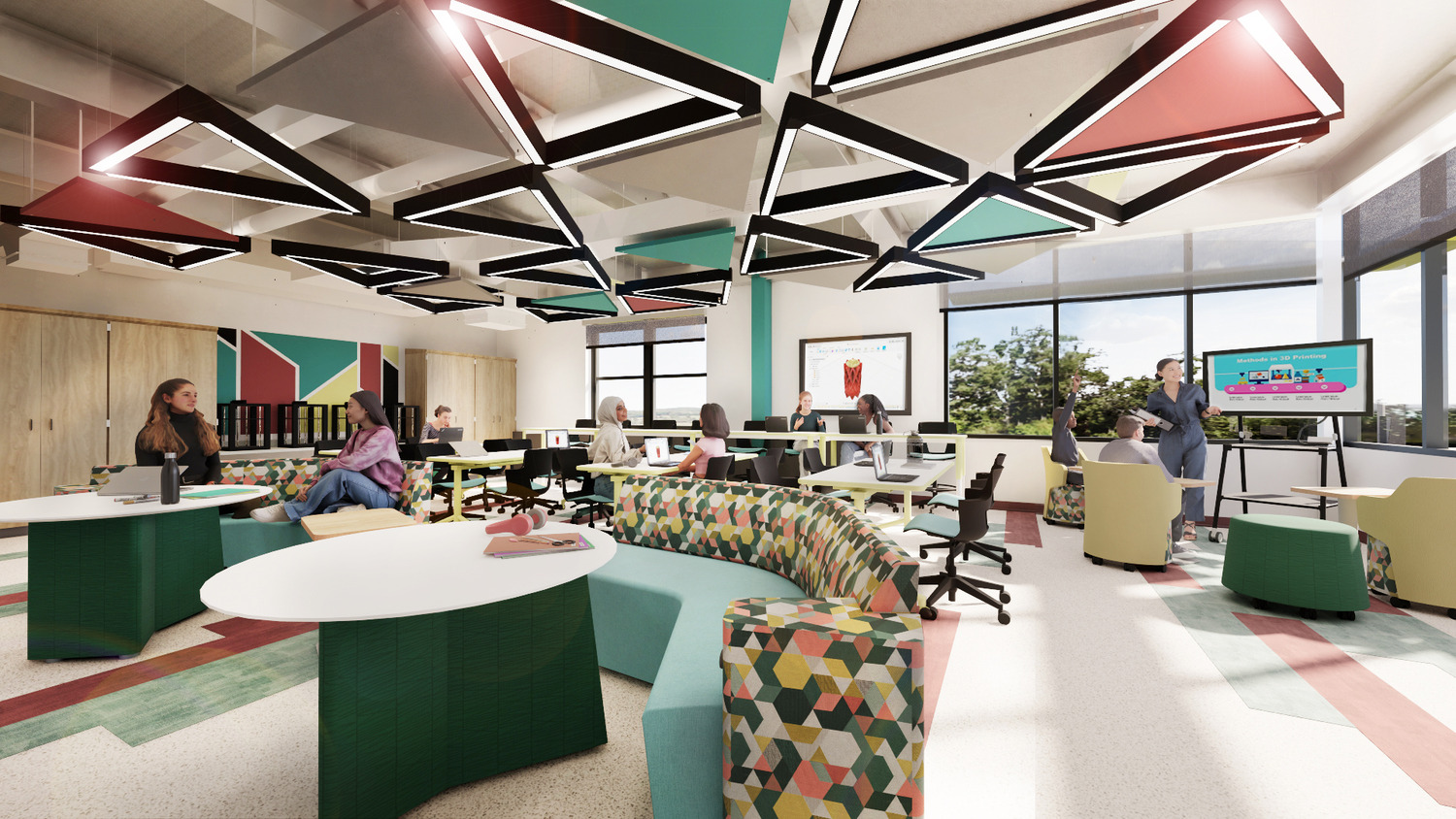
This upcoming classroom at Ossining High School will feature business-level aesthetics and zones for “Shark Tank”-style pitch presentations.
All of this is underpinned by robust infrastructure of high-speed internet, device compatibility, business software and production equipment, enabling everything from prototyping to digital marketing.
Defining Design Elements
→ Writable walls & display zones
→ Modular furniture
→ Open layouts with daylighting & visibility
→ Reliable power & high-speed data infrastructure
Programmatic Components
→ Student-led ventures
→ Startup pitch competitions
→ Financial literacy projects
→ Peer-to-peer product showcases
Linking Learning to Local Opportunity
Business incubators succeed when they blur the line between academics and industry. Many are intended for dual use, allowing employers to operate alongside students and bring authentic projects into the classroom for direct exposure.
This collaboration is key: 72% of business incubators in North America are backed by economic development, educational or government agencies. Some districts go even further, co-developing regional hubs that serve multiple schools and markets; these models expand access and unlock funding eligibility—such as the U.S. Economic Development Administration’s (EDA) Build to Scale Program or Perkins V CTE grants.
Workforce development boards, community colleges and companies typically provide in-kind contributions like equipment and coaching, creating a self-sustaining ecosystem of academic employment. These interactions often flourish into internships, or even permanent job offers following graduation.
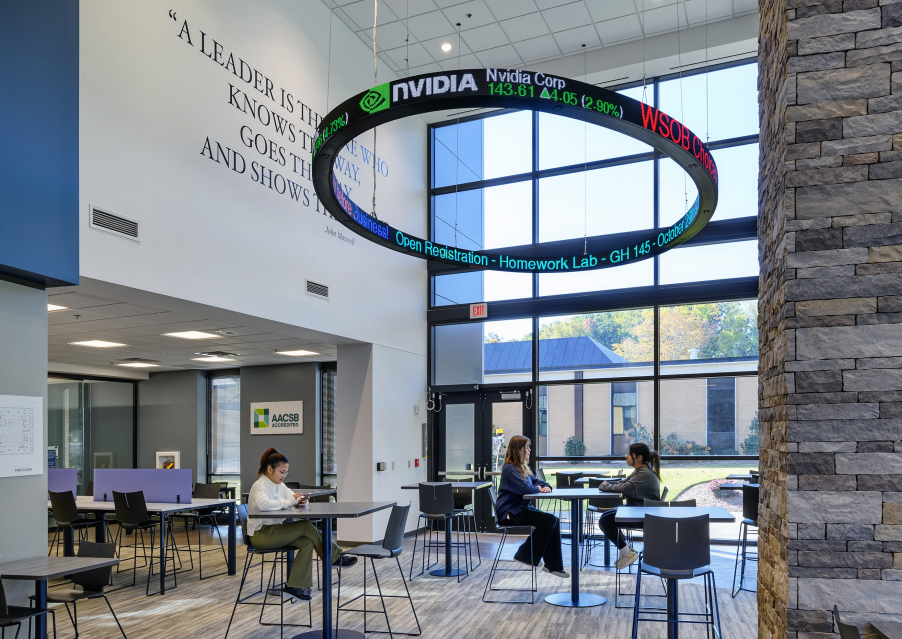
A lounge with a live stock ticker in the Wright School of Business at Dalton State College signals more than market updates—it reflects the school’s involvement with industry, hosting internships and preparing students for careers in finance, management and other fields.
5 TIPS for Getting Started
You don’t need a blank slate—or a massive budget—to plan a business incubator. Many districts begin by retrofitting underused spaces, harmonizing with existing CTE and adapting modern infrastructure that can evolve with time.
Proactive school leaders can build the foundation without over-committing up front. Here’s how to generate that momentum:
- Define Your Why. Understand your community’s unique needs, whether that means bringing ag-tech to rural areas or digital startups to urban schools, and clarify what the curriculum can help achieve—better literacy, higher skills, increased graduation rates, closed workforce gaps or all the above.
- Involve Stakeholders Early. Loop teachers, students, parents and area business leaders into the planning process to shape a cohesive vision and build buy-in.
- Audit Your Assets. Take stock of existing spaces and partnerships (you likely have some hidden opportunity).
- Design with Growth in Mind. Use capital improvement projects to introduce versatile layouts and durable finishes that can accommodate flexible pedagogies.
- Start with a Pilot. Test the waters with a student-run pop-up shop, host an idea pitch night or a rotating mentorship series. Small wins create proof of concept and set the stage for later expansion.
Redefining Career Readiness
Business incubators aren’t just engaging, they’re effective. When thoughtfully implemented, they deliver measurable impact, including:
- Higher college and career placement rates
- Accelerated learning
- Smoother coordination across departments and disciplines
- Enhanced relationships among families and business partners
By entrusting students with greater responsibility, schools do more than equip them for the workforce, giving them the tools to lead it instead. With the right strategy, a single classroom can spark a culture of ingenuity, compound community growth and help young minds become the business leaders of the future.
Empower the Next Generation
If you’re a district leader looking to evolve your approach to career readiness, business incubators can help you connect learning to life. Retrofitting a single room or launching a full-scale regional hub, CPL designs spaces that bridge education and industry—fueling students with opportunity and economic growth.
About the Author: Leslie Harris

