
Share This Story
As competitive gaming moves from dorm rooms to campus arenas, colleges and universities have a powerful opportunity to augment belonging through eSports. Far from a fleeting recreation trend, purpose-built gaming environments are emerging as sanctuaries for students who haven’t always found connection in varsity athletics or other campus programming.
For higher education leaders looking to increase engagement, the question is no longer whether to embrace eSports, but how design can help every student feel like part of the team.
The Growing Case for Inclusive eSports
Once dismissed as a niche hobby, eSports now mirror the structure and impact of traditional athletics, only built for digital natives. Players train strategically, collaborate with teammates, master specialized skillsets and compete in organized leagues that draw enormous in-person and online audiences.
The numbers reinforce momentum. In 2023, the global eSports market was valued at roughly $2 billion and is expected to nearly triple by 2029. Moreover, the National Association of Collegiate eSports (NACE) reports more than 260 member schools, 5,000+ student athletes and over $16 million in aid awarded annually.
The most compelling metrics aren’t financial though; they’re human. eSports creates new networks for:
- Commuter students who can drop in between classes
- Neurodiverse learners who thrive in structured, low-pressure social settings
- Students who don’t identify with conventional athletics
- Majors aligned with digital media, science and technology (65% of players study STEM, positioning eSports as a smart student life investment for tech-forward campuses)
Where Design & Planning Make the Difference
Ergonomics
Comfort is the foundation of successful eSports adoption and student affinity. Because players may remain seated for hours, furnishings must support posture, reduce strain and allow precision of movement. Adjustable-height desks and seating with modular lumbar and headrest options send a message that every body type and play style has been considered.
Students with wheelchairs or mobility devices are able to maneuver with wide pathways, clear sightlines and enough space to turn or reposition independently.
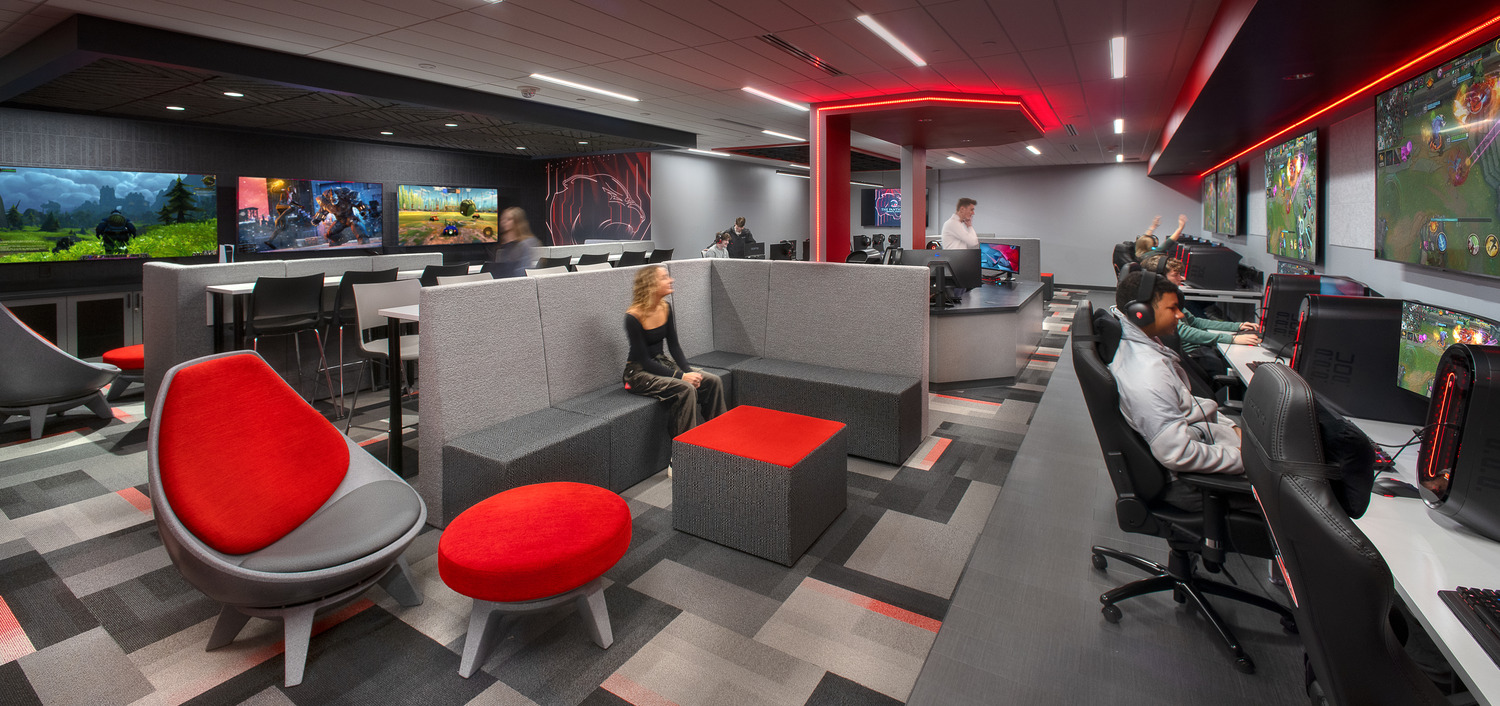
Sewickley Academy’s eSports suite features furniture that visitors can arrange themselves, fostering a sense of ownership over the space.
Dedicated lounge zones also enable moderated play and physical breaks, so students can stretch and reset without leaving the environment.
Sensory-Friendly Components
Lighting, acoustics and visuals can make or break a gaming experience, which requires intense focus. Controls that protect eyesight, combat distraction and create emotional safety are therefore essential. Lighting allows faculty to transform a room from spirited competition, to a relaxed hangout, to a bright classroom with a single toggle.
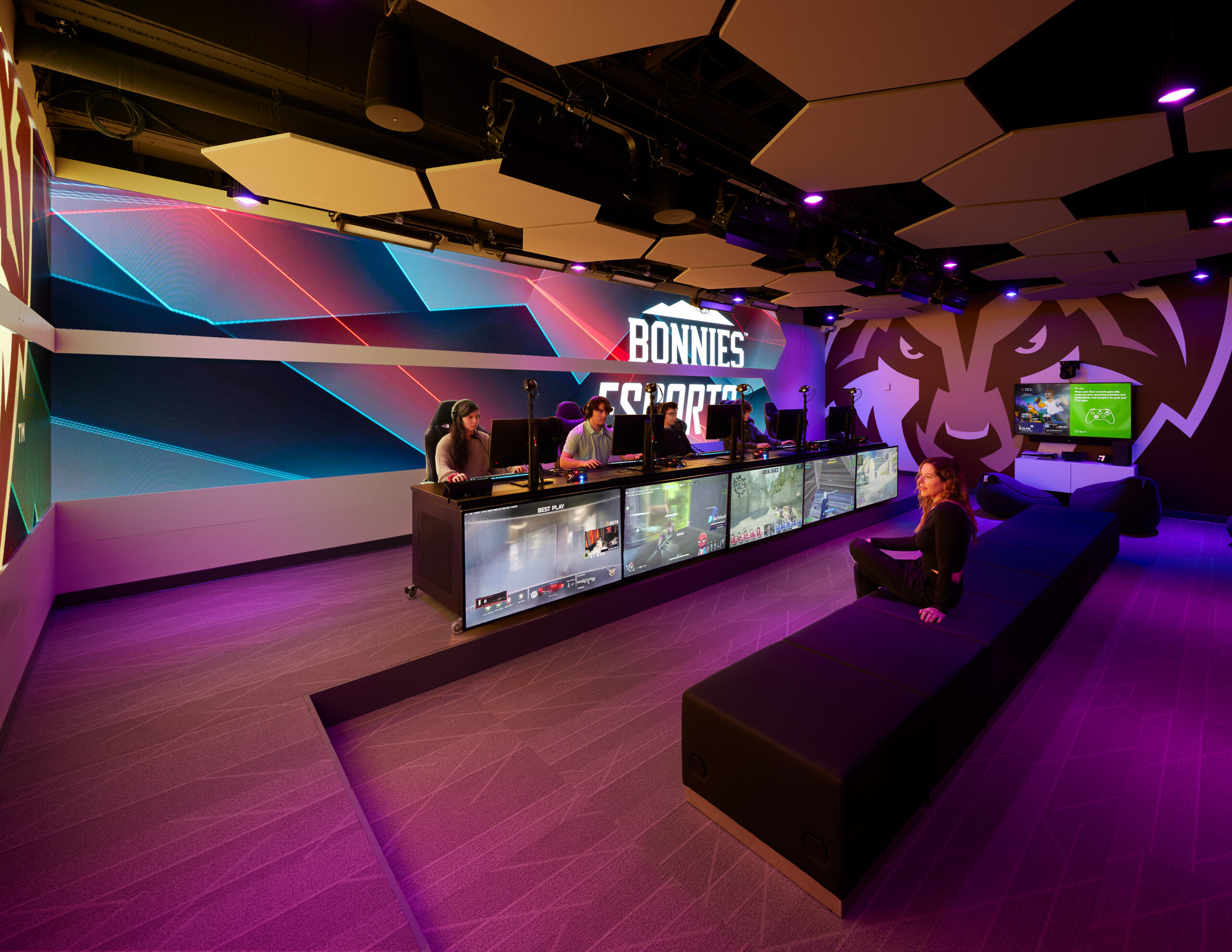
St. Bonaventure University’s eSports suite features professional PC gaming stations, indirect lighting, LED-backlit keyboards, dark ceilings and vibrant graphic wall accents designed for competitive play and live viewing.
Carefully placed acoustic panels absorb sound, ensuring that concentration is not interrupted by activity elsewhere on campus. This is particularly meaningful for neurodiverse students who may find common spaces overstimulating; eSports allow them to interact socially while focusing on a shared task, rather than navigating eye contact or cues that can feel stressful. In this way, sensory-friendly design signals representation, not just bodily ease.
Tech Equity
Universal access is one of eSports’ most compelling advantages. Most players use standard keyboards and mice, yet those with motor or dexterity differences can seamlessly integrate adaptive devices (such as alternative joysticks, modified controllers, oversized mice or switch-enabled keyboards) into the same stations, preserving room layouts and avoiding visibly separate setups.
This contrasts with standard accommodation models, where accessibility is often treated as a retrofit that disrupts design. Embedded from the start (not bolted on), eSports accessibility empowers students with physical disabilities to train alongside peers without ever feeling “othered.”
3 Key Steps for Getting Started
The ROI of Inclusion
Despite rapid growth, eSports don’t require stadium-scale expenditures. Most collegiate programs begin with just 11-15 stations—odd numbers that allow one machine to handle streaming duties for platforms like Twitch—yet the retention payoff is measurable. eSports players graduate at a rate of 85.9%, compared to the average 76.1%.
When done right, these suites serve as gateways where digital identity meets physical space: a place where students find people who speak their language, build confidence, feel seen and choose to stay.
Press Start on Belonging
With expertise in facility planning, student engagement and technology integration, CPL helps progressive colleges create eSports environments that make good on recruitment and retention goals.
About the Author: Melanie Panutsos

