
Share This Story
On one campus, leaders thought they needed more classrooms. Registrar schedules showed that some rooms had substantial availability, while others were booked heavily. Faculty conversations helped explain the difference: instructors gravitated toward rooms with the technology and furniture their courses required. The issue may not have been a shortage of classrooms, but a mismatch between the spaces available and how people needed to use them.
That kind of finding can change a capital conversation. Rising construction costs and deferred maintenance make it harder to fund every request. Leaders need to know which buildings support institutional priorities, what investment each requires and whether another use could create more value. A building’s age or repair list does not answer those questions by itself.

START WITH THE BUILDING’S ROLE
A facility condition assessment (FCA) identifies maintenance and capital improvement needs across a building or campus. It can help institutions reduce risk, extend an asset’s life and make informed investment decisions. A facility condition index (FCI) gives leaders a data-driven way to prioritize projects, allocate funding, benchmark facility performance and explain capital requests. Together, these measures make physical condition more visible, but they do not show whether a building is useful, accessible or aligned with institutional plans.
Therefore, leaders must also understand how each building serves academic programs, students and staff. Is the institution trying to grow a research program, improve the residential experience or make teaching spaces more effective? A building may be in sound condition but lack the infrastructure or layout needed for its next use. Another may have visible needs yet offer a viable structure and enough space to support a new role.
Campus identity and student experience also matter. Institutions may look at nearby campuses to understand what prospective students encounter while preserving the qualities that make their own campus distinctive. A residence hall, for example, may need updated systems and finishes as well as shared spaces where students can study and connect. A lab building, however, may need an entirely different layout or infrastructure to support priority programs.
TEST MORE THAN ONE FUTURE
A science-building feasibility study that CPL recently completed illustrates why institutions should test options before committing to a new facility. The college expected the study to recommend a new science building estimated to cost $50 million. The study explored whether an older building could support its program by retaining the main structural elements, reworking lab sizes, moving faculty offices to an adjacent building and adding a small exterior addition for an elevator and stairs.

The analysis showed how a renovation could support the science program, giving the college a basis to pursue funding for that work. That changed the capital conversation: leaders could evaluate adapting the existing building against a new facility rather than treating replacement as the only option.
Renovation is not always the better choice. The right path depends on the building’s condition, the program it must support, accessibility, infrastructure, operating needs and cost over time. A facilities team may compare targeted repairs, a larger renovation, a change in use, phased work, replacement or retirement. Detailed cost comparisons may require an outside consultant; an early cost-per-square-foot check is only one input.
Data can make that comparison more objective. Condition assessments can organize repair needs, while classroom schedules can show when and how rooms are used. But a spreadsheet alone cannot explain why one classroom is booked constantly while another is avoided. Faculty and staff conversations can uncover practical barriers, such as missing technology or furniture that does not support how a course is taught. Once the reason is clear, focused changes may address a capacity problem without adding space.
MAKE THE INFORMATION USABLE
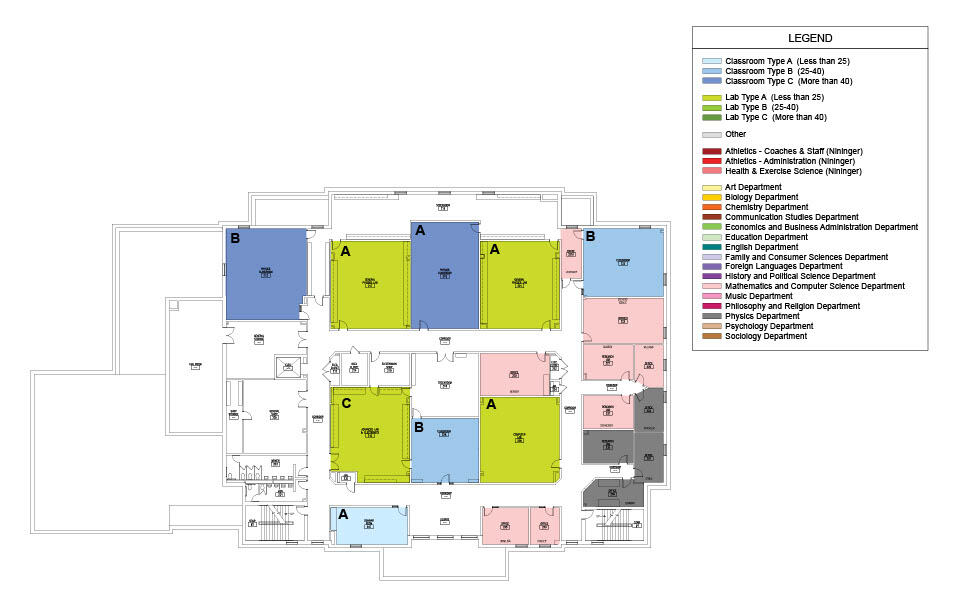
At Bridgewater College, an earlier classroom study mapped room types and documented technology and furniture on floor plans. The historical sample below illustrates one part of that work: classroom and lab types are mapped by capacity and department use. It reflects conditions documented at the time of the study, not current campus conditions.
A campus dashboard can bring building evaluations, current layouts, department information and planning documents into one navigable record. In one higher education example, users can search by building or capital cost and open a building-specific page with links to spatial data, an assessment summary, floor plans and blocking diagrams. A dashboard can make it easier to find what is known about a building and revisit the information when a future study is needed, rather than leaving data in separate reports.
The value comes from connecting information to decisions. A portfolio view can help an institution compare which buildings support current priorities, which need targeted investment and which may no longer justify continued capital. No single score or dashboard makes that choice. The tool overall helps leadership see the same evidence and discuss the trade-offs.
Plan around operations and long-term value
Even a sound plan has to work around the academic calendar. Many institutions cannot close a building for a year. Some renovations are timed for summer, winter or fall breaks, with design and preparation completed well before students leave. Other work is phased so classes or services can continue in part of the building. The schedule, temporary moves and time needed to reopen are part of the capital decision, not details to solve after it is made.
Sustainability adds another consideration, but reuse is not automatically the best answer in every case. Institutions can compare whether renovating or building new would result in a smaller carbon footprint, while also weighing energy performance, maintenance needs, likely service life and program fit. A building that remains useful and performs well may be a strong long-term asset; one that requires extensive upgrades and still falls short may call for a different plan.

Before committing capital, presidents, CFOs, trustees and campus leaders should be able to answer a few connected questions: What should this building enable? Who uses it, and how well does it serve them? What constraints would an update need to solve? How will the work affect operations? How do the options compare over the building’s expected service life?
The answers may point to renovation, repositioning, adaptation, phasing, replacement or retirement.
The goal is not to preserve every building or replace every outdated one. It is to understand what each asset can contribute, what it would take to make that contribution and how the choice supports the institution’s future. Better evidence cannot make a difficult decision easy, but it can help leaders make the decision deliberately and explain where limited capital will have the greatest value.
Looking for More Informed Investment?
Committing capital to a project on a college or university campus is a big decision with many considerations, and it can be difficult to find the starting point. Working with CPL’s Higher Education team, universities can transform their approach to investment, leading to purposeful, informed construction and buildings that align with the institution’s vision.
About the Author: Cheryl Graeub

